
Reviewed · TREME TOURS
Walking the Tremé: A Self-guided Audio Tour of New Orleans
Tremé tells its story through churches, music, Mardi Gras Indians, and the people who fought to keep their culture alive. This one-hour GPS-guided audio walk brings you to Saint Augustine Church, the Backstreet Cultural Museum, Louis Armstrong Park, and places tied to Mahalia Jackson and Louis Armstrong.
I like the price, just $9.99 per person, and the freedom to stop, pause, or move at your own pace. I also like the location-triggered narration, which can start the next story as you reach the right place. The catch is that the app has not worked perfectly for everyone, so download the tour before setting out and keep the route map handy.
In This Review
- Key points before you go
- Why Tremé makes a strong audio walk
- Starting at 801 North Rampart Street
- Saint Augustine Church and the War of the Pews
- The Backstreet Cultural Museum and Mardi Gras traditions
- New Orleans African American Museum grounds
- Mahalia Jackson’s New Orleans roots
- Louis Armstrong Park and the story of Satchmo
- How the GPS narration works in practice
- What the $9.99 price really buys
- Who will enjoy this Tremé walk
- Timing, access, and cancellation
- Should you book Walking the Tremé?
- FAQ
- How long does Walking the Tremé take?
- Where does the tour begin?
- Where does the tour end?
- What language is the audio tour offered in?
- Do I need my own smartphone?
- Can I use the tour without mobile data?
- Are museum admission fees included?
- What is the cancellation policy?
Key points before you go
- Hear the War of the Pews story at Saint Augustine Church: Learn how Creoles of color and white residents competed to purchase family pews in 1842.
- See Mardi Gras Indian costumes and second line umbrellas: The Backstreet Cultural Museum is a major visual stop, though admission fees are not included.
- Follow stories about Mahalia Jackson and Louis Armstrong: The tour connects Tremé’s streets with two of New Orleans’ best-known musical figures.
- Use the tour offline: The VoiceMap app includes offline audio, maps, and geodata after download.
- Plan for about one hour: You walk independently, with no transport, food, or smartphone supplied.
- Take care at highway crossings: One section of the route has prompted a warning about pedestrian-unfriendly crossings.
Why Tremé makes a strong audio walk

Tremé is not just a collection of old buildings. It is a neighborhood tied to Black New Orleans culture, Creole identity, brass bands, gospel, jazz, Mardi Gras Indian traditions, and community memory. An audio tour suits this setting because many important stories are not visible from the sidewalk.
The route gives you a sense of place through short, location-based narration. You are not following a guide holding a flag or waiting for a group to catch up. Instead, you use your phone and let the VoiceMap application tell you what to notice as you reach each stop.
That format has a clear benefit. You can linger at a church, pause outside a museum, or replay a section without slowing down anyone else. It also means you must manage the experience yourself. If the GPS signal misreads your location, the story may not begin at the right moment.
The audio is in English only. You need your own smartphone, and you should make sure the tour is downloaded before leaving your accommodation. Offline access is included, so you do not need to depend on a strong mobile signal for every part of the walk.
More Treme and Congo Square walks:
- New Orleans Treme’ Walking Tour
★ 5.0 · 240 reviews - New Orleans: Tremé African American & Creole History Tour
★ 4.9 · 208 reviews - True Voodoo History of NOLA’s Congo Square with Local Guide
★ 5.0 · 133 reviews
Starting at 801 North Rampart Street
The tour begins at 801 N Rampart Street, near the Tremé area. The booking includes directions to the starting point, and the tour is designed to begin once you reach the correct location.
Give yourself a few minutes before the official start time to open the VoiceMap app, check the map, and confirm that the audio files are available. This small bit of preparation matters. One user found the tour frozen on the download screen despite having full cell service and never got the audio to play at the starting point.
That appears to be an occasional technical problem rather than the normal experience. Other users found the app easy to access and said the GPS triggered the narration accurately. Still, an audio tour is only useful if the audio is ready when you arrive, so download everything in advance and carry a charged phone.
The walk lasts about one hour. The pace is yours, but time spent inside a museum or pausing for photographs will add to the visit.
Saint Augustine Church and the War of the Pews
One of the most memorable stories concerns Saint Augustine Church, whose address is 1210 Governor Nicholls Street. The church is also listed as the end point of the tour.
In 1842, Creoles of color began buying family pews inside Saint Augustine for Sunday worship. White residents responded by launching their own campaign to buy family pews. The result became known as the War of the Pews, a compact story that reveals much about race, class, religion, and social power in New Orleans.
This is exactly the kind of detail an audio walk can handle well. A church facade alone may not explain the tensions that played out inside. The narration gives you a reason to look at the building with sharper eyes and to think about who had access to public and religious life.
The supplied route information places Saint Augustine at the end, though the church story is listed first among the featured stops. Follow the map and audio prompts rather than assuming that every story will play in the order shown in a short tour description.
The Backstreet Cultural Museum and Mardi Gras traditions

The Backstreet Cultural Museum is likely to be the most visually striking stop. Its collection includes Mardi Gras Indian costumes, second line umbrellas, and photographs connected with New Orleans’ backstreet traditions.
The costumes are known for dazzling color and detailed design, but the important point is cultural rather than merely decorative. The museum helps explain the work, pride, and neighborhood traditions behind the public displays you may associate with Mardi Gras and second lines.
The tour can take you to the museum, but admission fees are not included. The supplied information does not give a separate ticket price or guarantee that entry is part of the audio route, so check the museum’s current arrangements before counting on an interior visit.
That distinction affects the value of the tour. At $9.99, the audio itself is inexpensive, but you may spend more if you enter attractions along the way. If you only want the outdoor route and narration, the low price is easier to judge. If you hope to see every collection mentioned, budget for any separate admission.
More walking tours in New Orleans:
- New Orleans Premier Ghost, Voodoo and Vampire Walking Tour
★ 4.5 · 12,856 reviews - New Orleans Food Walking Tour of the French Quarter with Small-Group Option
★ 5.0 · 6,118 reviews - St. Louis Cemetery No. 1 Official Walking Tour
★ 4.5 · 3,941 reviews - New Orleans French Quarter, Voodoo and Culture Walking Tour
★ 4.5 · 2,961 reviews
New Orleans African American Museum grounds

The walk also covers the grounds of the New Orleans African American Museum. The museum setting includes the original kitchen dependencies of Tremé’s Villa Meilleur and several homes showing different local building styles.
This stop adds an architectural side to the tour. You are not only hearing about famous musicians or festive traditions. You are also seeing how domestic spaces and older buildings help tell the story of a neighborhood.
Kitchen dependencies are particularly useful details because they point to the organization of historic households. The buildings can make social history more concrete than a list of dates and names. The tour’s narration helps connect those structures to the people and customs that shaped Tremé.
Again, personal admission costs are not included. The information supplied does not confirm whether the museum grounds, buildings, or exhibits are open during your visit, so treat entry as an extra possibility rather than a guaranteed part of the $9.99 experience.
Mahalia Jackson’s New Orleans roots

The route visits the Mahalia Jackson Theater of the Performing Arts and tells the story of Mahalia Jackson, one of the most important gospel singers associated with New Orleans.
After recording the highest-selling gospel song in history, Jackson gained international recognition. The tour also emphasizes that she did not forget her New Orleans roots. That local connection gives the theater stop more meaning than a simple photo opportunity.
You may find this section especially useful if you know Jackson mainly as a famous singer rather than as a figure tied to this city. The narration places her success beside her relationship with New Orleans, making the theater part of a larger story about home, faith, and public achievement.
The theater is a named stop, not a promise of a performance or backstage access. Plan to hear the story from the exterior unless the tour’s current arrangements or your own ticket provide something more.
Louis Armstrong Park and the story of Satchmo
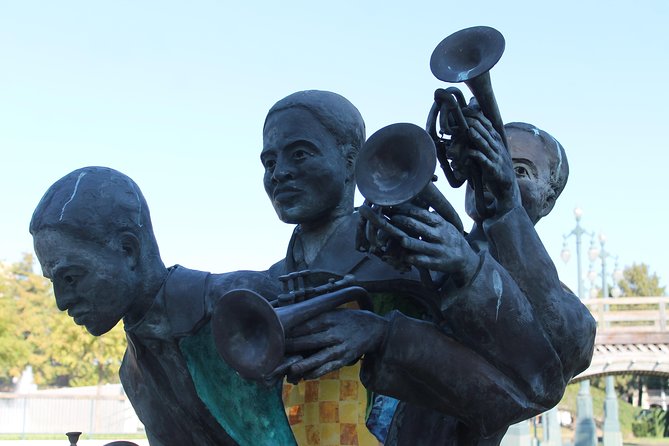
Louis Armstrong Park provides another major setting for the walk. The park honors one of New Orleans’ most famous musical ambassadors, Louis Armstrong, who was also called Satchmo and Pops.
Armstrong was born in 1901 just outside Tremé. The narration presents his early surroundings as a world that included churchgoers, hustlers, pimps, and musicians. That mix gives you a less polished picture of the neighborhood that helped shape him.
This section works best if you want to connect a celebrated musician with the streets and social world around his childhood. Armstrong is often presented as a symbol of New Orleans jazz, but the tour points toward the complicated community around his early life.
The park also raises a harder local question. One user felt the presentation was too softened and did not give enough attention to Tremé’s perseverance under pressure from the wider city and country. That criticism is worth keeping in mind. The tour offers a clear and accessible introduction, but it may not give every part of Tremé’s history equal weight.
You can use the audio as a starting point, not the last word. If the story prompts questions about who has access to the park or how the neighborhood has changed, you will have good subjects to explore elsewhere in New Orleans.
How the GPS narration works in practice

VoiceMap uses your phone’s location to trigger the narration. When it works well, the system tells you about the place where you are standing, which makes the route feel personal and easy to follow.
Several users found the pacing comfortable and the directions clear. One particularly useful feature is the way the narrator helps with street crossings and keeps you moving from one location to the next. You do not need to keep stopping to read long paragraphs on a screen.
The same technology can cause trouble. GPS is not perfect, and two sections have raised safety concerns because the route asks you to cross roads that are not designed for pedestrians. Do not follow an instruction blindly. If a crossing looks unsafe, stop the audio and choose a safer route, even if that means rejoining the tour a little farther along.
A practical setup makes a big difference:
- Download the tour, map, and geodata before starting.
- Bring your own smartphone with enough battery for the walk.
- Use headphones only if you can still pay attention to traffic and your surroundings.
- Keep the map open if a narration segment does not trigger.
- Pause rather than rushing across a road.
The tour gives you lifetime access, so you are not limited to one attempt. You can also listen again later, although the route makes the most sense when you are near the sites.
What the $9.99 price really buys
At $9.99, this is a low-cost way to get an organized introduction to Tremé. You receive the VoiceMap application, the audio, offline maps and geodata, directions to the start, and the ability to walk independently.
The value is strongest for a solo visitor or couple who wants structure without paying for a private guide. A traditional guided walk may offer live questions and local conversation, but this tour lets you set the pace and avoid joining a larger group. The maximum group size is listed as 10, though the self-guided format means you are not dependent on a group moving together.
The price does not cover your phone, transportation, food, drinks, personal expenses, or admission fees not included in the tour. Those exclusions are normal for an app-based walk, but they matter if you are planning a full day around the route.
I see the tour as a good value for its audio and route design, not as an all-inclusive Tremé experience. It gives you a framework for seeing several important places. You still need to decide which museums or attractions deserve extra time and money.
Who will enjoy this Tremé walk
I would choose this tour if you like history, music, architecture, and self-guided sightseeing. It suits people who want to stop for photographs, take a break, or listen again without asking a guide to wait.
It is also a good fit for families. The route gives children and adults something to listen for, from the War of the Pews to Mardi Gras Indian costumes and Louis Armstrong’s early life. You will need to supervise the pace and street crossings yourself.
Solo visitors can get a lot from the format because it provides direction without requiring a group. Couples who want a quiet walk may also prefer it to a scheduled tour.
I would hesitate if you dislike phone-based tours, expect a live guide, or want a fully developed account of every political and social force that shaped Tremé. The audio is praised for being well paced and informative, but one strong criticism is that its view can feel too gentle and limited. Bring your own questions and allow extra time to explore beyond the scripted stops.
Timing, access, and cancellation
The tour is available every day around the clock, with listed operating hours from midnight to 11:59 p.m. That means you can begin when it fits your schedule, although the route’s practical comfort and safety will depend on conditions at the time you walk.
Confirmation is provided at booking. Service animals are allowed, and the tour is near public transportation. Most people can participate, but you are responsible for walking between locations and handling the app yourself.
Free cancellation is available if you cancel at least 24 hours before the scheduled start time. Cancellations within 24 hours are not refunded, and changes made inside that period are not accepted. The cut-off uses New Orleans local time.
Should you book Walking the Tremé?
Book it if you want a cheap, flexible introduction to Tremé with strong stories about Saint Augustine Church, Mardi Gras Indian culture, Mahalia Jackson, Louis Armstrong, and local Black architecture.
Before you go, download the tour and map, charge your phone, and treat every road crossing with care. Also plan for possible admission costs if you want to enter museums or other sites.
I would not make this your only source for understanding Tremé, especially if you want a fuller account of displacement, community resistance, and the neighborhood’s harder history. But as a one-hour orientation with lifetime access, a low price, and the freedom to walk alone, it is a sensible choice for curious visitors who are comfortable using a smartphone.
FAQ
How long does Walking the Tremé take?
The tour lasts approximately one hour. Stops, photographs, museum visits, and pauses can make your total outing longer.
Where does the tour begin?
The tour begins at 801 N Rampart Street, New Orleans, Louisiana 70116, USA.
Where does the tour end?
The listed end point is Saint Augustine Catholic Church at 1210 Governor Nicholls Street, New Orleans, Louisiana 70116, USA.
What language is the audio tour offered in?
The tour is offered in English.
Do I need my own smartphone?
Yes. A smartphone is not included. You use the VoiceMap application to access the audio, maps, and location-based directions.
Can I use the tour without mobile data?
Yes. Offline access to the audio, maps, and geodata is included. Download the material before beginning the walk.
Are museum admission fees included?
No. Personal expenses and admission fees not included during the tour are excluded from the price.
What is the cancellation policy?
You can receive a full refund by canceling at least 24 hours before the experience start time. Cancellations or changes made within 24 hours are not accepted for a refund.
More Audio Tours in New Orleans
- Metairie Cemetery Stories: A Self-Guided Audio Tour
★ 4.0 · 12 reviews - A Walk in the Park: City Park New Orleans Audio Tour
★ 4.5 · 12 reviews - Self Guided Audio Ghost Tour in New Orleans in 6 Languages
★ 4.1 · 12 reviews
More Self-Guided Walks in New Orleans
- Avery Island Experience- Tabasco & Jungle Gardens Self-guided tour
★ 4.5 · 297 reviews - Ghosts of New Orleans: Self-Guided Haunted Audio Walking Tour
★ 4.0 · 32 reviews - Baton Rouge Historic Downtown Self-Guided Audio Walking Tour
★ 4.0 · 19 reviews - Self Guided Walking Tour of New Orleans’ Historic Garden District
★ 4.5 · 13 reviews
Just added around New Orleans
- New Orleans Garden District Tour★ 5.0 · 8 reviews
- New Orleans Seance Experience★ 4.0 · 8 reviews
- Airport and City Transfers in New Orleans★ 5.0 · 8 reviews
- Sin and Tonic Pub Crawl in New Orleans★ 4.5 · 8 reviews
- The New Orleans Darkness Tour★ 4.4 · 9 reviews
- New Orleans Plantation Tour with Transportation★ 5.0 · 9 reviews
- New Orleans Self-Guided Kayak Bayou Swamp Tour★ 5.0 · 9 reviews
- Historic Carrollton Neighborhood Walking Tour★ 5.0 · 9 reviews
Treme Tours, compared.

True Voodoo History of NOLA’s Congo Square with Local Guide
Read our review →
New Orleans Voodoo, Storyville, Treme, Walking Tour
Read our review →
Private French Quarter, Voodoo, and Congo Square Walking Tour
Read our review →

New Orleans Driving Tour with Bayou St. John, City Park, Treme
Read our review →Browse the lists this tour appears in