
Reviewed · FRENCH QUARTER TOURS
New Orleans French Quarter Walking and History Tour
The best thing about this tour is its range. In two hours, you move from the Mississippi River levee to the French Market, Jackson Square, St. Louis Cathedral, old courtyards, and Pirate’s Alley. You are not just looking at pretty balconies. You are learning how swamp, fire, slavery, music, religion, and literature shaped New Orleans.
I like the small maximum of nine people, which gives you a fair chance to hear the guide and ask questions. I also like the mix of major sights and easy-to-miss details, including the spot where Tennessee Williams wrote A Streetcar Named Desire and William Faulkner’s former home. The main consideration is simple: this is a two-mile walking tour with little time to sit, and the meeting instructions should be checked carefully because the tour material names both Musical Legends Park and Cafe Beignet on Royal Street.
- The $29 price covers two hours of guided history, with no entry fees required at the listed stops.
- The route connects the river, French Market, Jackson Square, and St. Louis Cathedral in one compact introduction.
- Small groups make the storytelling more personal, with a maximum of nine participants.
- Guides such as David Higgins and Dave Roberts bring local character, with music, humor, and personal New Orleans stories.
- The tour includes difficult subjects, including slavery, Creole society, and the placage system.
- Morning and afternoon start times make it easier to fit around meals, museums, or a night out.
In This Review
- Why this two-hour walk is a smart first look at New Orleans
- Start at Cafe Beignet and get your bearings
- The Mississippi River explains why New Orleans exists
- French Market: a quick look at food and trade
- Jackson Square gathers the city’s symbols
- St. Louis Cathedral and the 1788 fire
- Courtyards, Creole society, and the placage system
- Literary landmarks and Pirate’s Alley
- Ursuline Convent and the older layers of the quarter
- What the pace and group size mean in practice
- Who will get the most from this tour
- Booking, timing, and the small practical catches
- Should you book the French Quarter Walking and History Tour?
- FAQ
- How long is the New Orleans French Quarter walking tour?
- What is the price of the tour?
- What language is the tour offered in?
- How large is the group?
- Where does the tour meet?
- Where does the tour end?
- Are food and drinks included?
- Does the tour enter St. Louis Cathedral?
- Can I cancel for a full refund?
Why this two-hour walk is a smart first look at New Orleans
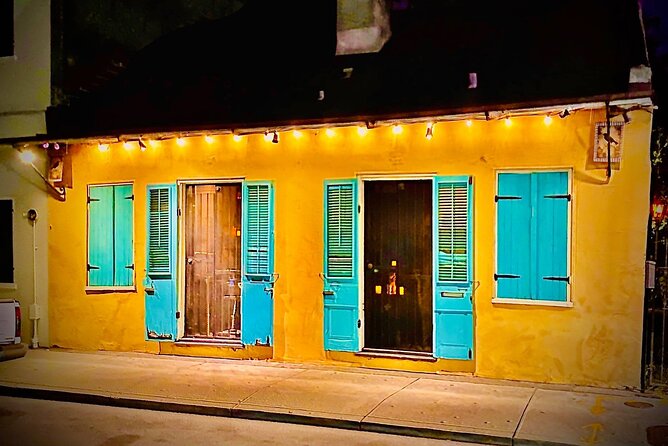
The French Quarter is easy to wander and surprisingly easy to misunderstand. You can spend an hour admiring iron balconies without knowing why the buildings look the way they do, or why the city needed levees to survive. A good guide gives those sights a sequence, and this route does that well.
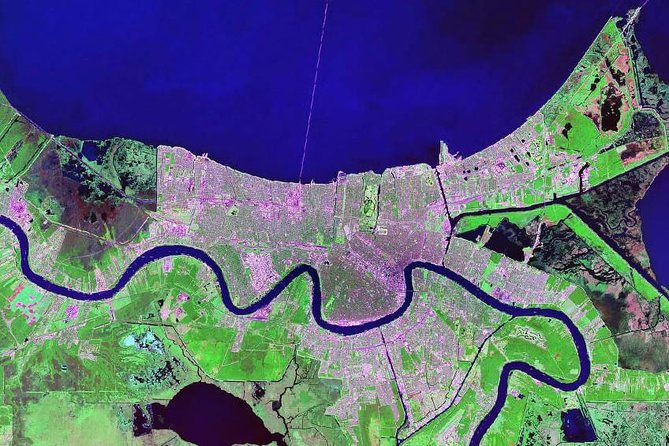
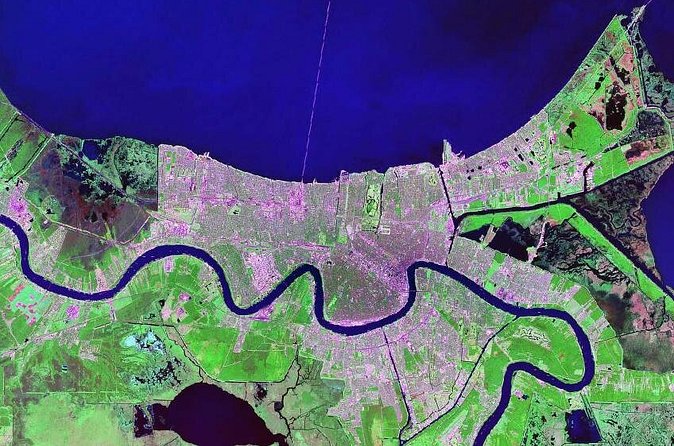
The walk begins in or near the French Quarter and reaches the Mississippi River early. That choice matters. Before you study courtyards and cathedral paintings, you learn that New Orleans was built on low, wet ground. The levee system helped turn difficult terrain into a place for homes, farms, trade, and a major port city.
The experience is priced at $29 per person, which is fair for a two-hour, English-language walking tour with a local guide. You do not pay for museum admission on this outing, and the value comes from context, route planning, and access to stories you would likely miss on your own.
This is not a food tour, a ghost tour, or a music-only walk. It is a broad orientation to the French Quarter. That makes it particularly useful on your first day, when you want to understand the area before returning to specific museums, restaurants, or music clubs.
Start at Cafe Beignet and get your bearings
The stated meeting point is Cafe Beignet at 334 Royal Street, although the tour description also refers to Musical Legends Park as the starting place. Both are in the French Quarter, but you should rely on the exact confirmation details you receive when booking and arrive early.
Cafe Beignet is a practical meeting spot because you can begin with coffee and a beignet if time allows. One useful tip is to arrive before the scheduled start rather than trying to eat after the group has gathered. Food and drinks are not included, so budget separately for breakfast or a refreshment.
The tour is offered in English, with morning and afternoon start times. The group limit of nine is a real advantage in a narrow, busy quarter. A small group can gather around a building or courtyard without blocking the street, and you can usually ask a question without interrupting a large crowd.
Some of the strongest guide feedback centers on David, also referred to as Dave in the tour material. He is described as a musician and stand-up comedian with a strong connection to New Orleans. Dave Roberts is also named by the provider, so the exact guide may vary by date. Do not book this expecting one guaranteed personality, but do expect a guide chosen to explain the city in an engaging way.
More ways to walk the French Quarter:
- New Orleans Food Walking Tour of the French Quarter with Small-Group Option
★ 5.0 · 6,118 reviews - New Orleans French Quarter, Voodoo and Culture Walking Tour
★ 4.5 · 2,961 reviews - French Quarter Historical Sights and Stories Walking Tour
★ 5.0 · 2,724 reviews
The Mississippi River explains why New Orleans exists
The first major lesson comes at the riverbank. Paddlewheel steamboats may be visible on the water, but the important subject is the levee system. Your guide explains how engineers and workers made life and agriculture possible on land that was naturally vulnerable to flooding.
This is a useful start because it turns the river from scenery into a force that shaped the city. New Orleans grew as a place of movement and trade, but that success came with constant work to control water. You begin to see the French Quarter not as an isolated set of old buildings, but as part of a city built around the Mississippi.
The river stop takes about 15 minutes, while the opening French Quarter section is listed at about 30 minutes. The pace is leisurely, but the tour keeps moving. You should not expect a long break at the river or a chance to sit and watch boats.
If the weather is hot, the riverbank may feel exposed. If the weather is poor, the experience can be canceled, with a different date or a full refund offered. Wear comfortable shoes and bring what you need for the conditions. The route is only about two miles, but you will be on your feet for most of the two hours.
French Market: a quick look at food and trade
The route continues through the French Market, identified as the oldest open-air market in the United States. The tour presents its earlier connection with Native American bartering, then brings you through the stalls and local food culture.
The market stop is brief, listed at about five minutes. That is enough for orientation, but not enough for a full meal, careful shopping, or a relaxed look at every stall. If you want to return for produce, fish, Creole dishes, or souvenirs, note the location and come back later.
I like this stop because it adds daily life to the architectural story. The French Quarter is not only churches and government buildings. It is also a place where food, commerce, and local traditions meet. Still, the short visit means you should treat it as a preview rather than a market tour.
Jackson Square gathers the city’s symbols
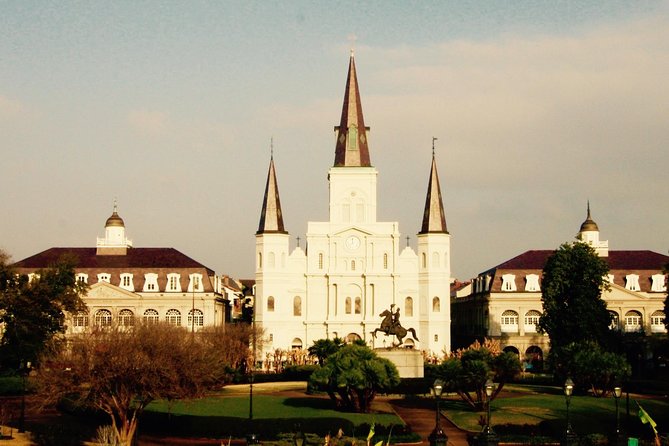
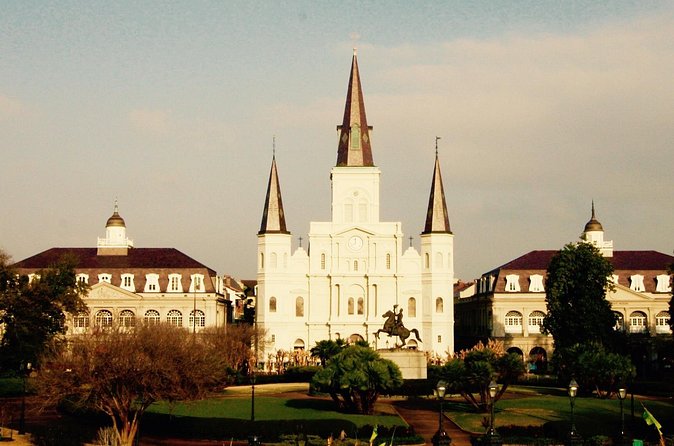
Jackson Square is the emotional center of the walk. It occupies the site of the original Place d’Armes and honors Andrew Jackson. From here, several important buildings sit close together, making this one of the most efficient parts of the route.
You see the Cabildo, the Presbytere, St. Louis Cathedral, and the Pontalba Apartments. These buildings frame the square and help explain the French Quarter’s familiar architectural style. The Pontalba Apartments are identified as the oldest apartment buildings in the United States, an unusual detail that gives the square extra interest.
The Cabildo was built between 1795 and 1799 and once served as a center of government. It is now part of the Louisiana State Museum. The Presbytere, built in 1791 to match the Cabildo, contains permanent exhibits about New Orleans’ resilience and celebration.
The tour does not appear to include a full museum visit inside the Cabildo or Presbytere, so plan a separate stop if you want to see the exhibits. That is not a flaw at this price, but it is important to know. The guide’s job here is to show you how the buildings fit together and explain why they matter.
More history tours in New Orleans:
- New Orleans Garden District History Walking Tour
★ 5.0 · 2,879 reviews - New Orleans Small-Group Haunted History Carriage Tour
★ 4.5 · 2,289 reviews - New Orleans Haunted History Ghost Tour
★ 4.5 · 2,084 reviews - Paddlewheeler Creole Queen Historic Mississippi River Cruise
★ 4.5 · 1,948 reviews
St. Louis Cathedral and the 1788 fire

St. Louis Cathedral gives the route one of its strongest architectural and historical pauses. The guide takes you inside the cathedral and points out the location where the Great New Orleans Fire of 1788 began.
That fire helps explain why so much of the French Quarter has a unified appearance. Rebuilding after the disaster created the classic style many people associate with New Orleans: courtyards, balconies, shutters, and tightly packed buildings. The fire is not just an isolated event. It is a key reason the district looks as it does today.
The cathedral portion is listed at about 20 minutes. That is long enough for an explanation and a look inside, but not a substitute for a full museum or architectural tour. Be respectful while inside. This is an active religious site as well as a landmark.
The walk’s strength is the way the guide connects events to buildings. Instead of memorizing dates, you can look at the square and understand how government, religion, housing, and fire shaped the same few blocks.
Courtyards, Creole society, and the placage system
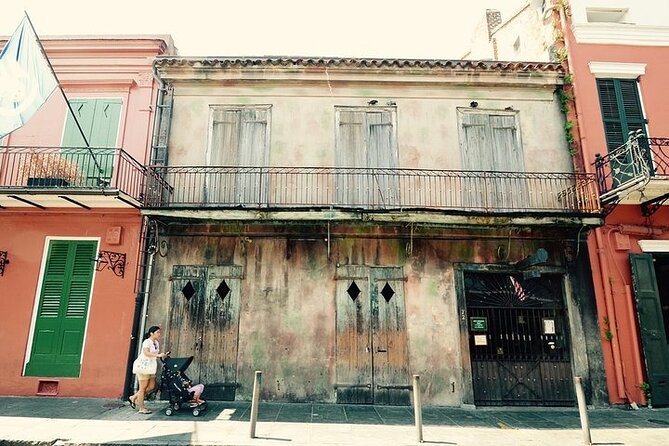
The route becomes more complicated in a Creole courtyard and at the former Quadroon Ballroom. Here, the guide discusses Creole society, slavery in South Louisiana, and the system known as placage.
This is an important part of the experience because New Orleans history is not only colorful architecture, food, and music. It also includes unequal systems of race, wealth, gender, and power. The former lives of Creole mistresses and the social arrangements connected with placage require more care than a quick romantic story about the old city.
The guide’s task is to explain those complexities in a short time. You should expect an introduction rather than a full scholarly treatment. Still, including this material makes the walk more honest and gives the buildings a human context.
The balcony of the former Quadroon Ballroom adds a physical connection to the story. You are not simply hearing about an abstract social structure. You are standing in a place connected with the people and arrangements being discussed.
Literary landmarks and Pirate’s Alley
Literature becomes the thread linking several smaller stops. You pass the building where Tennessee Williams wrote A Streetcar Named Desire and enter William Faulkner’s former home. You also walk through Pirate’s Alley, where local stories include prison escapes and dueling.
These stops are especially useful if you know the writers, but you do not need to be a literary fan to enjoy them. They show how the French Quarter has served as both a home and a setting for artists. The area is not just preserved history. It has also been a working neighborhood where writers, musicians, performers, and other residents lived.
Pirate’s Alley is listed at about 10 minutes. The guide may also point out film locations and other literary sites along the way. Street musicians provide another layer of sound as you walk, although music is an incidental part of the route rather than a scheduled performance.
One review describes the tour as feeling like a walk with a musician friend who takes pride in the city. That is a good way to understand the tone you may get from a guide such as David or Dave. Expect facts, humor, personal observations, and room for questions, rather than a dry recitation of dates.
Ursuline Convent and the older layers of the quarter
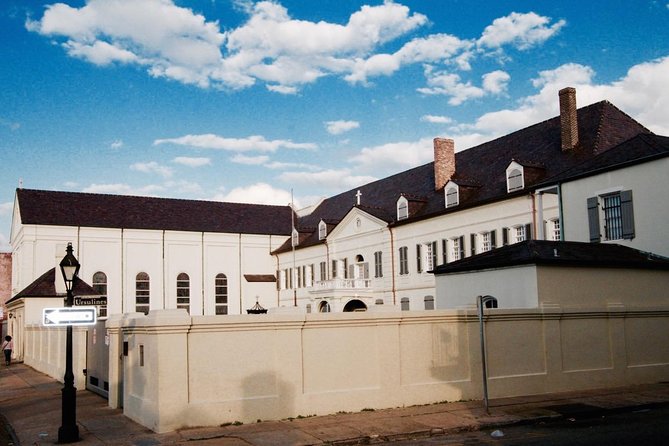
The Old Ursuline Convent is another short but worthwhile stop. You stand outside the Mississippi Valley’s oldest building and hear about early colonization efforts in Louisiana.
The stop is listed at about 10 minutes, so this is primarily an exterior explanation. The building offers a chance to think about the city’s early European religious and colonial history before you return to the livelier streets of the quarter.
This stop also helps balance the route. You have already heard about markets, government, fire, literature, and slavery. The convent adds religious institutions and early settlement to the picture. In a two-hour introduction, that broad range is one of the tour’s best features.
What the pace and group size mean in practice
The advertised distance is about 2 miles, or 3.2 kilometers, at a leisurely pace. Guides stop often enough to explain buildings and answer questions, and the overall timing gives each main area a short focus.
You should still wear comfortable shoes. The tour involves walking from the river to the market, across Jackson Square, through courtyards and alleys, and back toward the Mississippi River levee. The route is not strenuous for most people, but it is continuous.
A group of no more than nine is small enough for a personal feel. It also means the quality of the experience depends partly on the guide’s delivery and the interests of the people in your group. In a very small booking, the guide may be able to shape the discussion around your questions. In a fuller group, you may hear a wider range of interests but have less time to talk.
The tour ends at or near Jackson Square according to the meeting information, while the route description says it finishes near the Mississippi River levee. Because those details do not match perfectly, check the day’s end point before making a tight dinner reservation or arranging transport.
Who will get the most from this tour
I would choose this walk for a first visit, especially if you have only one full day in New Orleans. It covers the basic map of the French Quarter and gives you enough context to make later exploring more rewarding.
It also suits:
- Couples who want history with humor and a relaxed pace.
- Families who prefer short stops and stories over long museum visits.
- Solo visitors who value a small group and a clear route.
- History fans interested in architecture, colonization, slavery, and urban development.
- Literature and film fans who want to connect the quarter with Tennessee Williams and William Faulkner.
- People who want local orientation before visiting Frenchman Street or other parts of the city.
I would choose another experience if your main goal is food tasting, nightlife, ghost stories, or an in-depth museum visit. This walk gives you a wide introduction, not a narrow specialty.
Booking, timing, and the small practical catches
The tour is booked an average of about 20 days ahead, so reserve early if your schedule is fixed. Confirmation is provided at booking, and the ticket is mobile, which keeps the process simple.
Food, drinks, and hotel pickup are not included. Plan to make your own way to the meeting point and allow extra time to find Cafe Beignet on Royal Street. Since the tour may begin near Musical Legends Park according to the description, read the confirmation closely.
Most people can participate, but the supplied information does not give detailed accessibility specifications. If you have concerns about walking two miles, standing for long periods, or entering courtyards and historic buildings, ask the provider before booking.
The cancellation terms are generous if you plan ahead: cancel at least 24 hours before the local start time for a full refund. Cancellations or changes within 24 hours are not refunded, except when poor weather causes the operator to cancel.
The experience currently carries a 4.6 rating from 288 reviews, with 90 percent of customers recommending it. The praise centers on clear storytelling, humor, local insight, a comfortable pace, and guides who answer questions. There are also a few complaints about meeting the guide or receiving timely refund communication. That makes it especially important to arrive early, confirm the meeting point, and keep your phone available.
Should you book the French Quarter Walking and History Tour?
Book it if you want a compact, good-value introduction to New Orleans that goes beyond the postcard views. The route covers the river, levees, market, square, cathedral, convent, courtyards, literary sites, and difficult social history in a manageable two hours.
The strongest reason to choose it is the combination of breadth and small-group attention. You see the major landmarks, but you also hear about fires, writers, duels, music, Creole society, and the city’s struggle with water. For a first morning or afternoon in New Orleans, that is a useful foundation.
Skip it if you dislike walking, need long museum visits, or want a tour built around food or nightlife. For everyone else, $29 is a sensible spend, especially when your time in New Orleans is short. Confirm the exact meeting and ending points, wear comfortable shoes, and arrive ready to listen. You will leave with a clearer map and a better sense of why the French Quarter looks, sounds, and feels the way it does.
FAQ
How long is the New Orleans French Quarter walking tour?
The tour lasts approximately two hours and covers about 2 miles, or 3.2 kilometers, at a leisurely pace.
What is the price of the tour?
The price is $29 per person.
What language is the tour offered in?
The tour is offered in English.
How large is the group?
The experience has a maximum of nine travelers.
Where does the tour meet?
The stated meeting point is Cafe Beignet at 334 Royal Street in New Orleans. The tour description also refers to Musical Legends Park, so check your booking confirmation for the exact meeting instructions.
Where does the tour end?
The meeting information lists Jackson Square as the end point, while the route description says the walk ends near the Mississippi River levee. Confirm the final location with the operator if you have plans immediately afterward.
Are food and drinks included?
No. Food and drinks are not included. You can arrive early at Cafe Beignet if you want to purchase a beignet or a drink before the tour.
Does the tour enter St. Louis Cathedral?
Yes. The guide takes you inside St. Louis Cathedral and explains the location where the Great New Orleans Fire of 1788 began.
Can I cancel for a full refund?
Yes, if you cancel at least 24 hours before the experience start time. Cancellations or changes made less than 24 hours before the start are not refunded. If poor weather causes the tour to be canceled, you will be offered another date or a full refund.
More Walking Tours in New Orleans
- New Orleans Premier Ghost, Voodoo and Vampire Walking Tour
★ 4.5 · 12,856 reviews - St. Louis Cemetery No. 1 Official Walking Tour
★ 4.5 · 3,941 reviews - Ghost and Vampire Walking Tour Of The French Quarter
★ 4.5 · 2,406 reviews - New Orleans Adults-Only True Crime and Ghost Walking Tour
★ 5.0 · 1,666 reviews
Just added around New Orleans
- New Orleans Garden District Tour★ 5.0 · 8 reviews
- New Orleans Seance Experience★ 4.0 · 8 reviews
- Airport and City Transfers in New Orleans★ 5.0 · 8 reviews
- Sin and Tonic Pub Crawl in New Orleans★ 4.5 · 8 reviews
- The New Orleans Darkness Tour★ 4.4 · 9 reviews
- New Orleans Plantation Tour with Transportation★ 5.0 · 9 reviews
- New Orleans Self-Guided Kayak Bayou Swamp Tour★ 5.0 · 9 reviews
- Historic Carrollton Neighborhood Walking Tour★ 5.0 · 9 reviews
French Quarter Tours, compared.

New Orleans Food Walking Tour of the French Quarter with Small-Group Option
Read our review →
New Orleans French Quarter, Voodoo and Culture Walking Tour
Read our review →
French Quarter Historical Sights and Stories Walking Tour
Read our review →
Ghost and Vampire Walking Tour Of The French Quarter
Read our review →
New Orleans City Tour: French Quarter, Garden District & Cemetery
Read our review →
New Orleans French Quarter Food Tour: Cajun, Creole and Culture
Read our review →
New Orleans French Quarter and More Carriage Ride
Read our review →
French Quarter walking Food Tour Famous Flavors of New Orleans
Read our review →Browse the lists this tour appears in